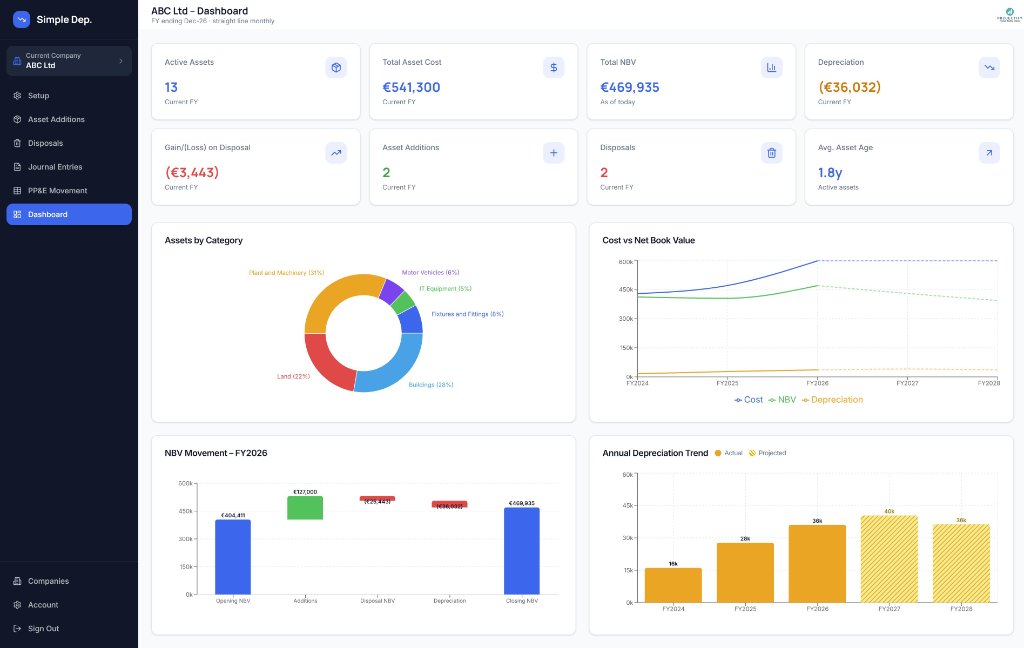
Fixed Asset and Depreciation Management, Made Simple
Simple Depreciation helps SMEs, accountants, and finance teams manage fixed assets, calculate depreciation, record disposals, and prepare audit-ready reports without relying on complex Excel schedules.
Set up asset categories, add or import assets, track in-use dates, calculate depreciation and related journal entries automatically, and export clear reports for management, accounting, and audit purposes.
Track fixed assets
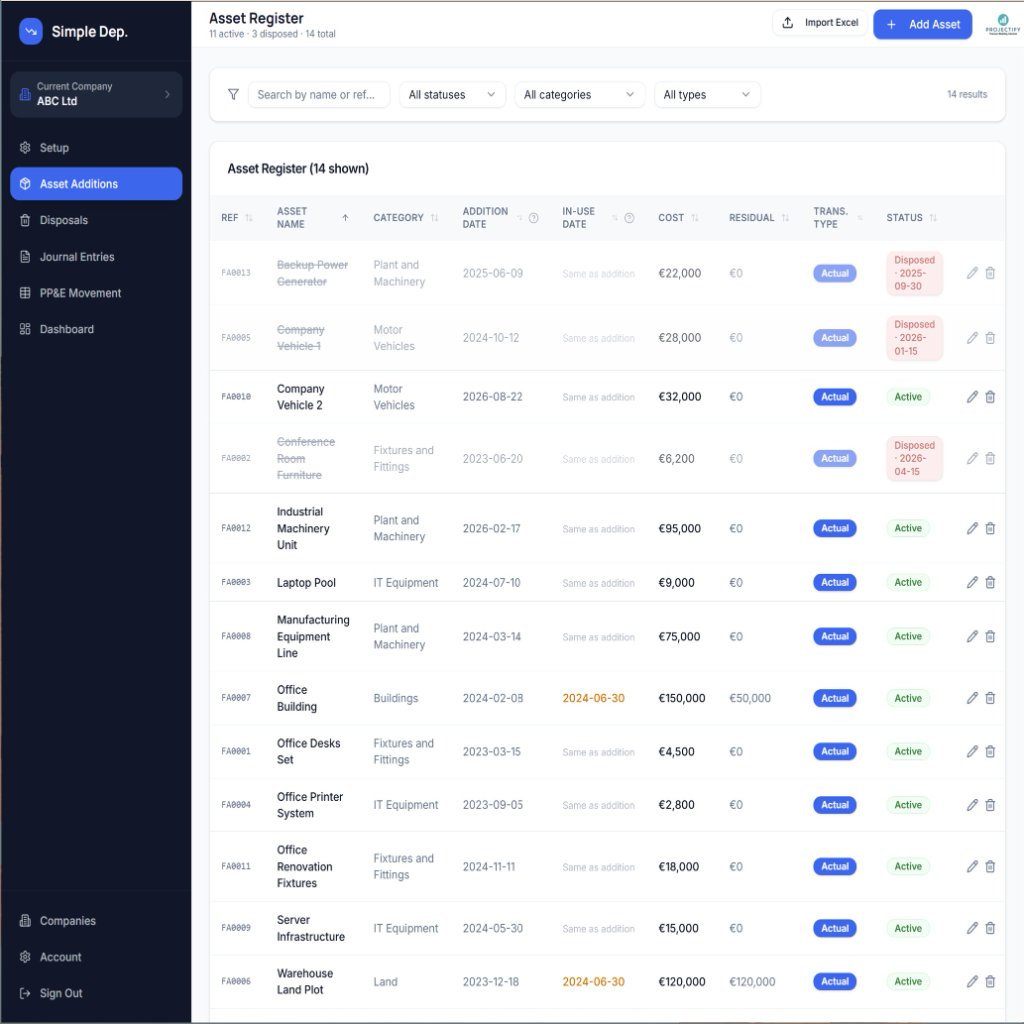
Maintain a complete register of all your fixed assets with costs, dates, and categories.
Calculate depreciation
Automate straight-line depreciation with flexible methods and useful life settings.
Export audit-ready reports
Generate PP&E schedules, journal entries, and full audit packs in PDF or CSV.
A Clean And Intuitive Interface
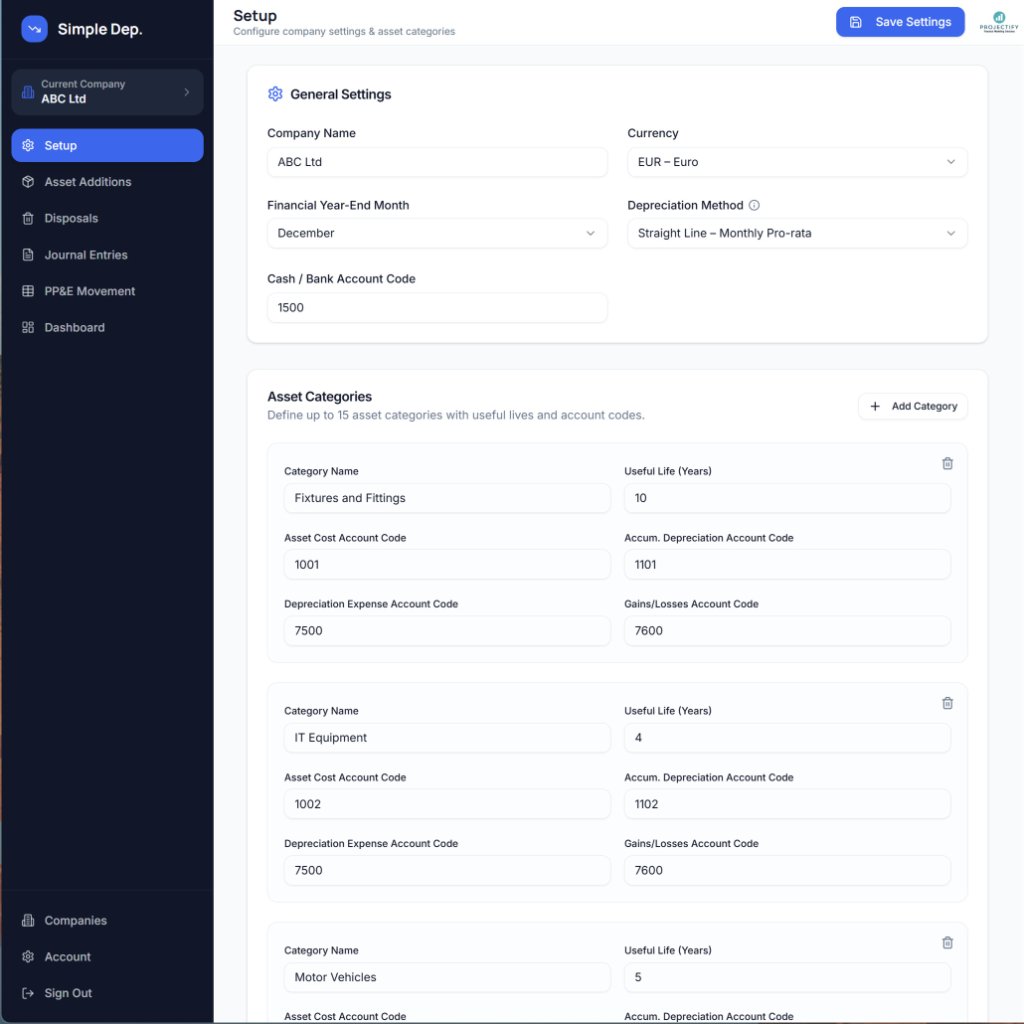
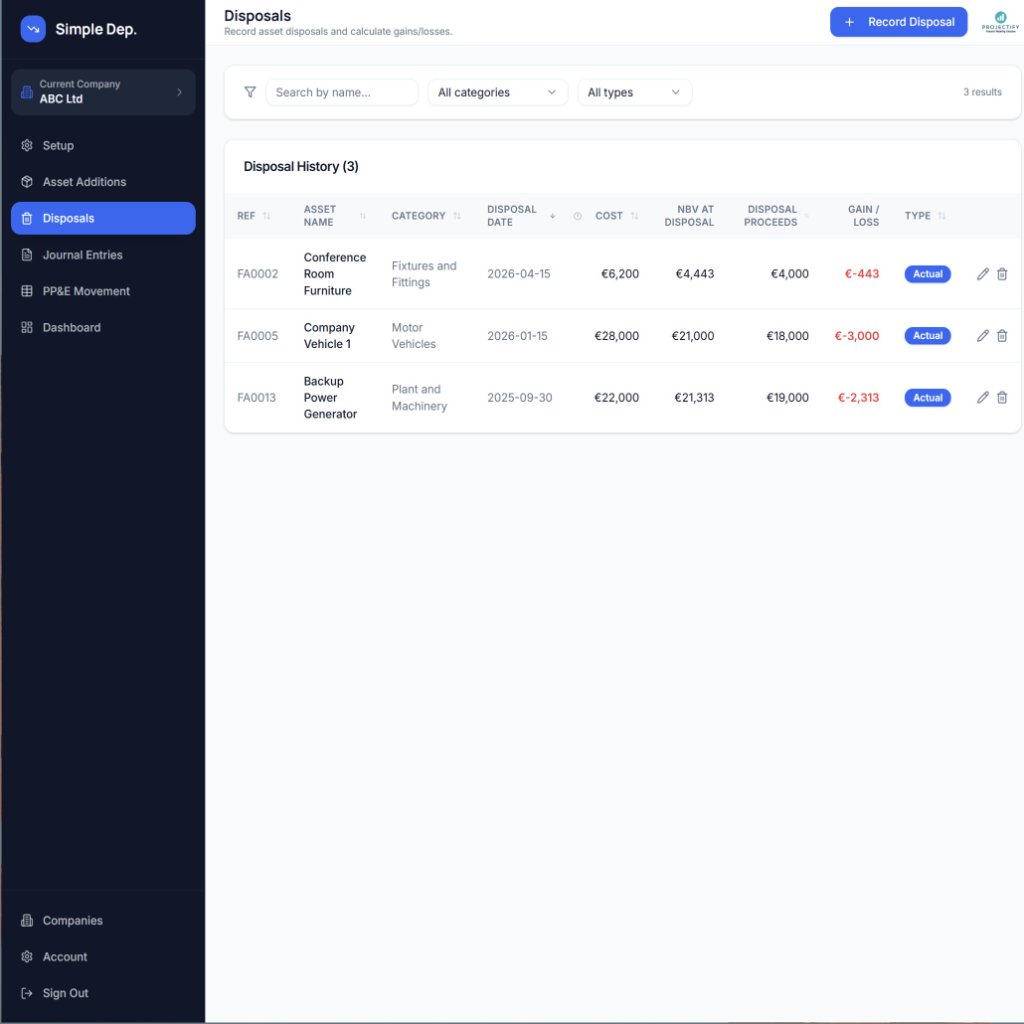
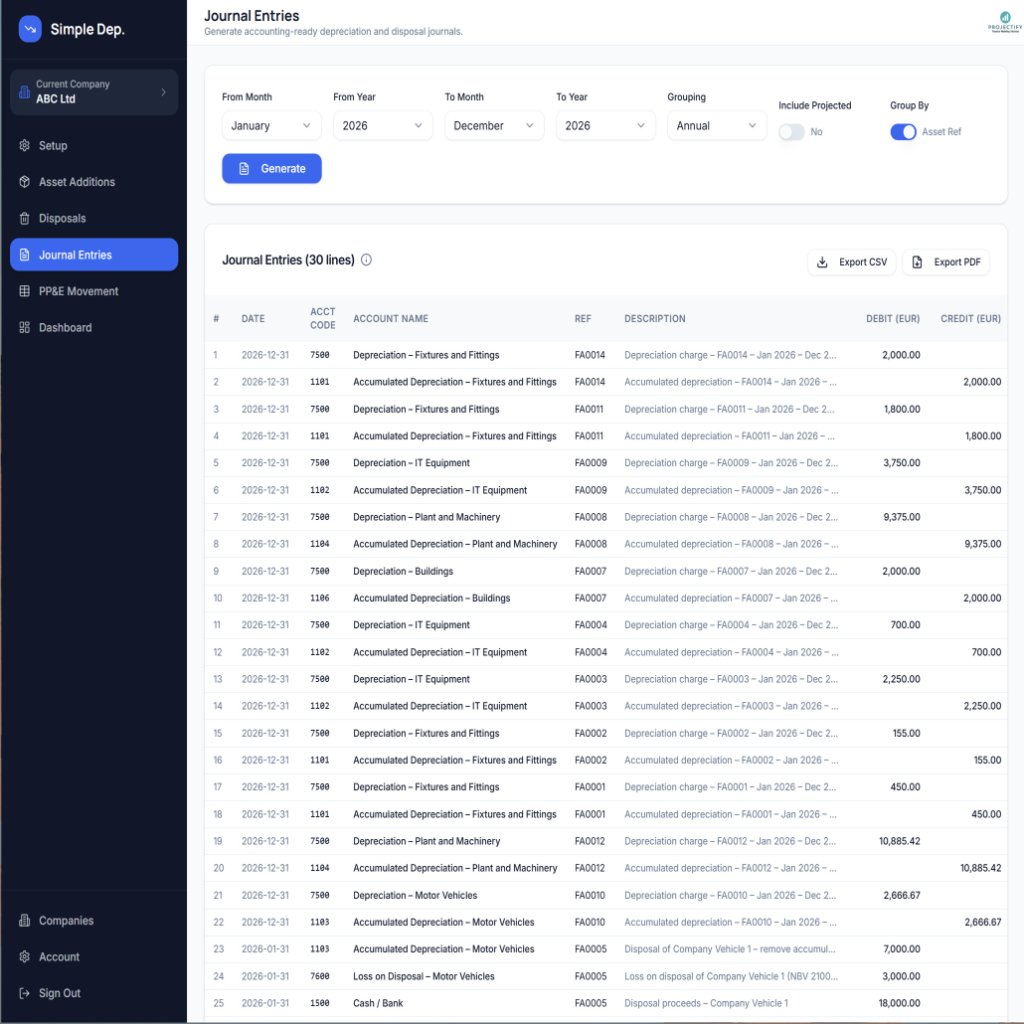
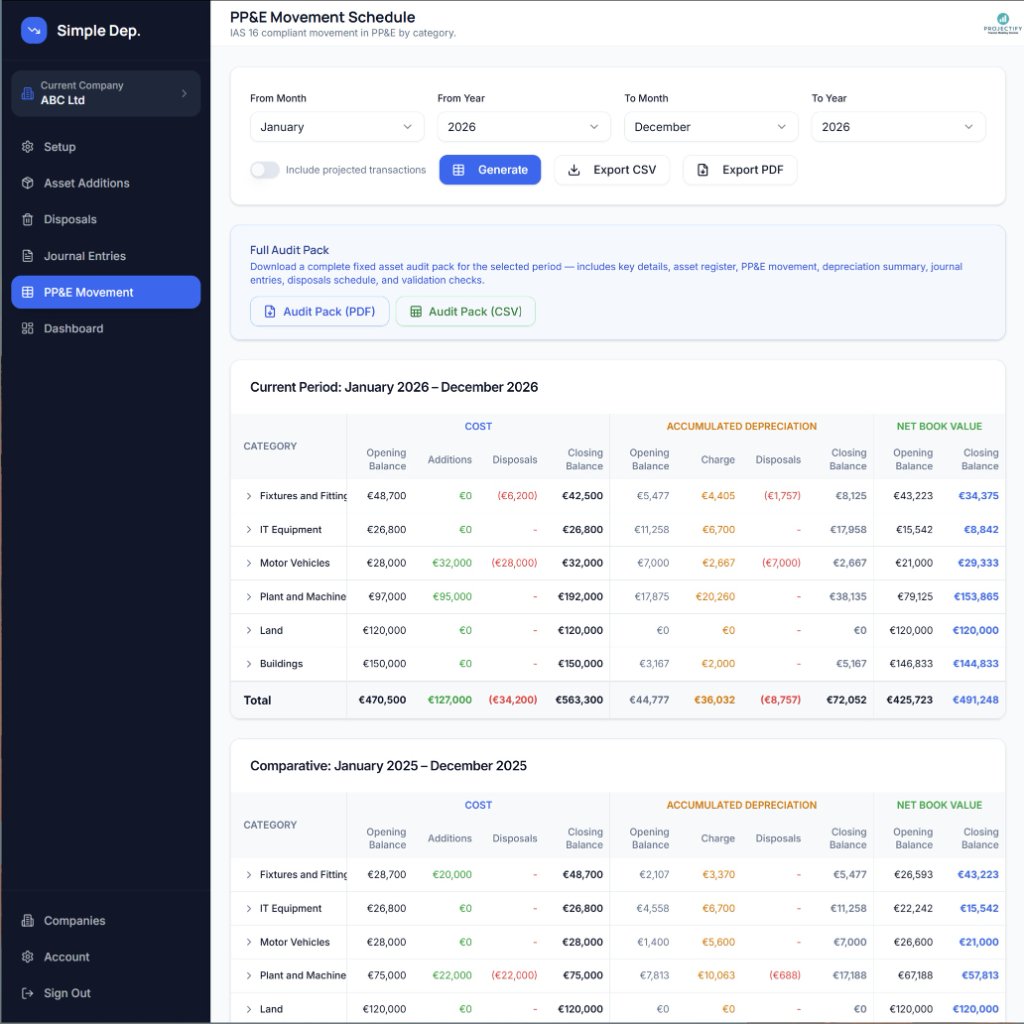
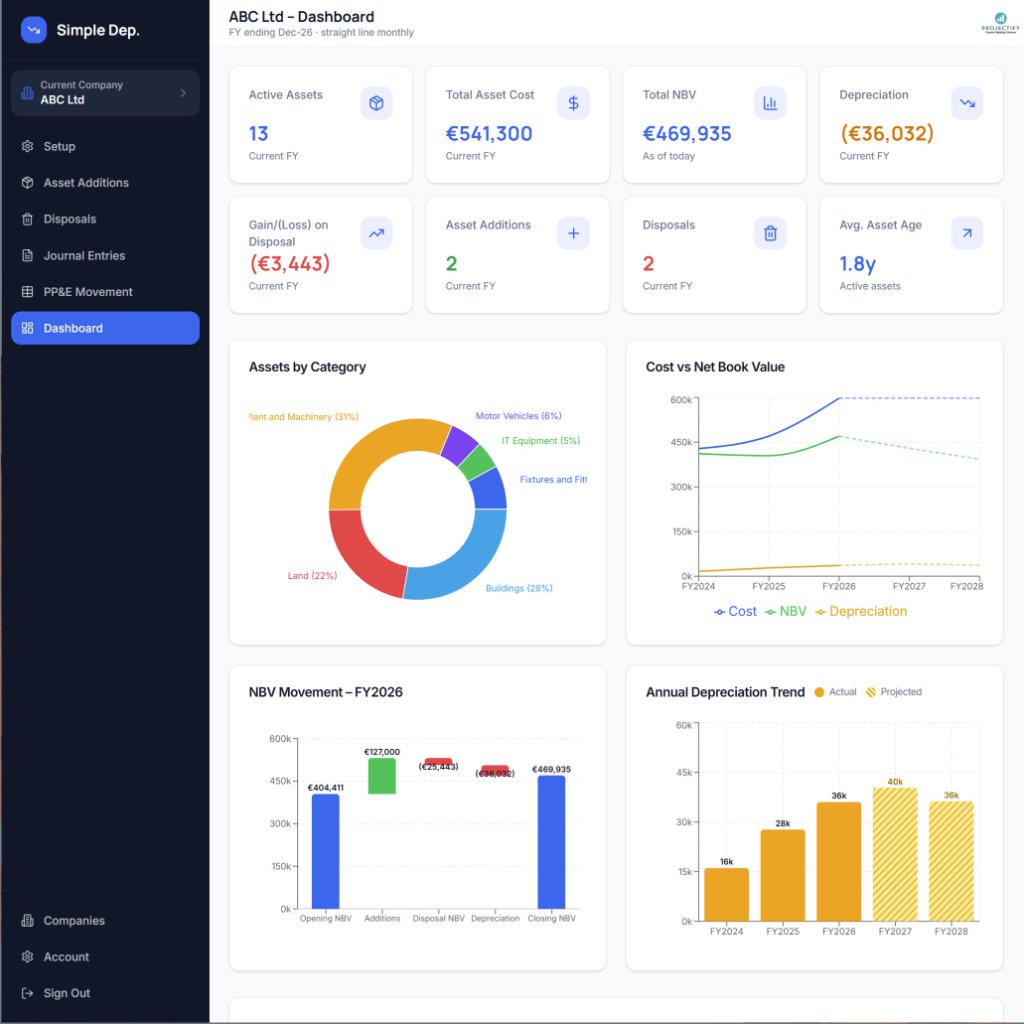
Every screen is designed to make fixed asset management fast and straightforward, no training required.
Everything You Need
From asset register to journal entries, all in one place, no more Excel formulas.
Flexible Depreciation
Straight-line depreciation calculated automatically with separate addition and in-use dates. Choose from monthly pro-rata, full-year in year of purchase, or no-first-year methods to match your accounting policy.
Visual Dashboards
Understand your asset base at a glance with charts, NBV over time, depreciation trends, and a period-by-period summary table.
Journal Entries
Generate double-entry accounting journals for depreciation and gains/losses on disposal for any period. Export to PDF or CSV in seconds.
PP&E Movement Schedules
Full fixed asset roll-forward showing opening balances, additions, disposals, depreciation, and closing NBV — standard across IFRS, US GAAP, and local frameworks.
Disposal Management
Record asset disposals and automatically calculate the gain or loss on disposal, including the journal entries to derecognise the asset and clear accumulated depreciation.
Actual & Projected
Mark assets as actual or projected to forecast depreciation over future years. Dashboards and reports clearly distinguish between confirmed and forecast figures.
Bulk Import from Excel
Import asset additions in bulk from Excel. Avoid manual data entry for large asset registers and get up and running quickly.
Multi-Company
Manage multiple companies from one account. Each with its own currency, financial year, depreciation method, and asset register.
Audit Trail
Maintain a complete timestamped audit trail of changes showing who made each change and when for improved accountability and audit readiness.
Audit Pack Download
Generate a professional audit-ready pack including asset register, PP&E movements, depreciation summaries, journal entries, disposals and validation checks.
Simple, Transparent Pricing
Start free. Upgrade when you're ready.
Free
- 1 company
- Up to 10 active assets
- 1 user
- All core features included
- No Excel import or exports
- Evaluation purposes only
Starter
€200/year (save 17%)
- Up to 3 companies
- Up to 100 assets
- 2 users per account
- PDF & CSV exports
- Bulk import
- Audit Pack download
Pro
€450/year (save 17%)
- Up to 10 companies
- Up to 1,000 assets
- 5 users per account
- PDF & CSV exports
- Bulk import
- Audit Pack download
Trusted By Finance Teams
"Simple Depreciation replaced our 15-tab Excel model completely. It takes minutes to generate journal entries that used to take hours."
Finance Manager
SME, Ireland
Frequently Asked Questions
Everything you need to know about depreciation and fixed asset management.
What is depreciation?+
Depreciation is the systematic allocation of the cost of a tangible fixed asset over its useful life. It reflects the reduction in value of an asset due to wear and tear, obsolescence, or the passage of time. Depreciation is recorded as an expense in the income statement and reduces the carrying value of the asset on the balance sheet.
What is the straight-line method of depreciation?+
The straight-line method is the most common depreciation approach. It spreads the depreciable cost of an asset (cost minus residual value) evenly across its useful life. For example, an asset costing €10,000 with a €1,000 residual value and a 5-year life would generate €1,800 of depreciation per year. Simple Depreciation supports monthly pro-rata, full-year, and no-first-year straight-line variants.
What are fixed assets?+
Fixed assets (also called Property, Plant & Equipment or PP&E) are long-term tangible assets held by a business for use in operations rather than for sale. Examples include machinery, vehicles, buildings, computers, and office equipment. They are capitalised on the balance sheet and depreciated over their useful lives.
What is Net Book Value (NBV)?+
Net Book Value is the carrying amount of a fixed asset on the balance sheet. It is calculated as the original cost of the asset minus accumulated depreciation to date. NBV decreases each period as depreciation is charged, and reaches the residual value at the end of the asset's useful life.
What is a PP&E movement schedule?+
A PP&E movement schedule (also called a fixed asset roll-forward) shows the opening balance, additions, disposals, depreciation charge, and closing balance of fixed assets and accumulated depreciation for a period. It is required under IAS 16 and is a standard disclosure in financial statements.
What happens when an asset is disposed of?+
When a fixed asset is sold or scrapped, it is derecognised from the balance sheet. The gain or loss on disposal is the difference between the disposal proceeds and the net book value at the date of disposal. Simple Depreciation automatically calculates this gain or loss and generates the corresponding journal entries.
Can I import my existing asset register?+
Yes. Simple Depreciation supports bulk import of assets from Excel or CSV files on the Starter and Pro plans. This makes it easy to migrate from an existing spreadsheet without manual data entry. The Free plan does not include bulk import.
How many assets can I create?+
It depends on your plan. The Free plan supports up to 10 active assets across 1 company, and is intended for evaluation and testing purposes. The Starter plan allows up to 100 assets per company, and the Pro plan supports up to 1,000 assets across up to 10 companies.
Can I export my data?+
Yes. On Starter and Pro plans you can export PP&E movement schedules, journal entries, and depreciation reports as PDF or CSV, and download a full audit pack. The Free plan includes all core features for evaluation but exports and audit packs are not available.
Is my data secure?+
Absolutely. All data is encrypted in transit and at rest. Simple Depreciation is built on enterprise-grade infrastructure with 99.9% uptime. We never share your data with third parties without your consent.
Can I cancel my subscription?+
Yes, you can cancel at any time from your Account page. Your plan will remain active until the end of the current billing period, after which it will revert to the Free tier. There are no cancellation fees.
What payment methods are accepted?+
We accept all major credit and debit cards (Visa, Mastercard, American Express) via Stripe, our secure payment processor. All transactions are encrypted and processed in compliance with PCI-DSS standards.
Who is Simple Depreciation meant for?+
Simple Depreciation is designed for accountants, finance managers, and SME owners who manage fixed assets and need accurate depreciation calculations and compliant reporting — without the complexity of full ERP systems.
How does the platform ensure journal entries balance?+
Every journal entry generated by Simple Depreciation follows double-entry bookkeeping rules. Depreciation charges debit the depreciation expense account and credit accumulated depreciation. Disposal entries derecognise the asset cost and accumulated depreciation, with the balancing entry going to gain/loss on disposal. Each entry is verified to balance before being shown.
What KPIs and metrics are available on the dashboard?+
The dashboard shows total asset cost, net book value (NBV), accumulated depreciation, annual depreciation charge, number of active assets, and assets disposed in the period. Charts include NBV over time, depreciation by category, and an IAS 16 PP&E waterfall. You can also view a period-by-period summary table with monthly, quarterly, or annual breakdowns.
Still Prefer Excel?
We've Got You Covered
We built Simple Depreciation with the same logic you'd find in a professional depreciation Excel model — but if you still prefer Excel, we also offer a dedicated Excel calculator built by our team at Projectify.
- Fixed asset register with full transaction history
- Dashboard with key charts and metrics
- Movement in PP&E schedule
- Disposal management with gain/loss calculations
- Accounting-ready journal entries
Depreciation / Amortisation Calculator — Excel Model by Projectify